

Upstream, downstream
On memory-keeping, river tracing and what flows down with gravity

One of my big fears in this life is losing my memory.
I’m not someone with a great memory, at least not in a conventional sense like who/what/where/when. But this is often why I write, and it’s why when I go too long without writing I feel this alternating sensation of itch followed by uncomfortable numbness. Neither are fun feelings. One is the body screaming for something elusive, while the other is her slipping away.
In recent years, I’ve gravitated toward poetry, which is an art form that begs for an accurately traced memory, a fact that can be found in the fascia. But whenever I’m in the throes of straight-up Material, when life comes in hard and full and my heart is splintered, when I’m in the waiting room, keeled over, getting The Call, holding a baby dove after they’ve been mauled to death by my dog, then is not the time for a pen. Something feels off about that, like a musician jotting pillow talk in a notebook while his lover pretends to sleep, like I’d be missing the beauty in pursuit of grasping to remember it. Like I’d be trying to enjoy snowflakes by catching them with a butterfly net. Like, I should just let it fall, ya know? It’s gonna pile up anyway.1
But the stuff of life can live frozen in the body for a somatic winter of sorts. Sometimes this is a coping strategy, and it’s a good one, or at least it’s the only one. And sometimes, it’s just the course of seasonality. Eventually, one day, spring comes, and the memory-melt can be released downstream where a writer can reduce it over an open flame of language. That’s when poets mine the marrow, and novelists alchemize the gold. I just have to trust that what I lack in fast fingers, I’ll make up for in somatic storage.
It’s also good to have a loved one who appreciates the smell of your neck or the sound of your voice just as much as the version of you who slinks away to try to make something that might outlive you both.
The Weather Report
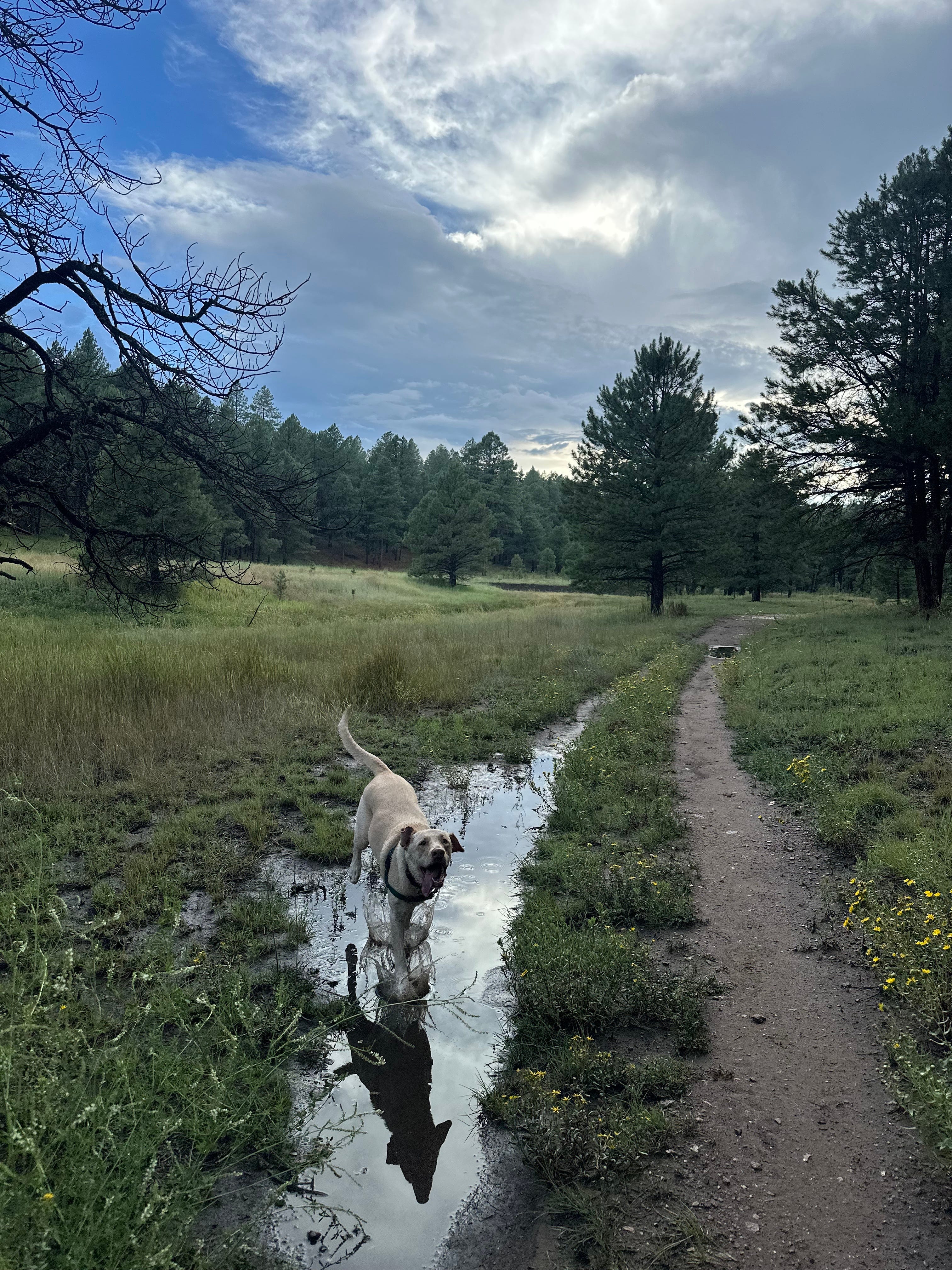
I reside in the desert, which is a bad place to be if you write best in the morning but also ever want to go outside. We recently dodged this dilemma with a trip to Flagstaff, where it blessedly rained every day. Maddie was grateful, too. So many puddles. She almost never gets those.
A Memory
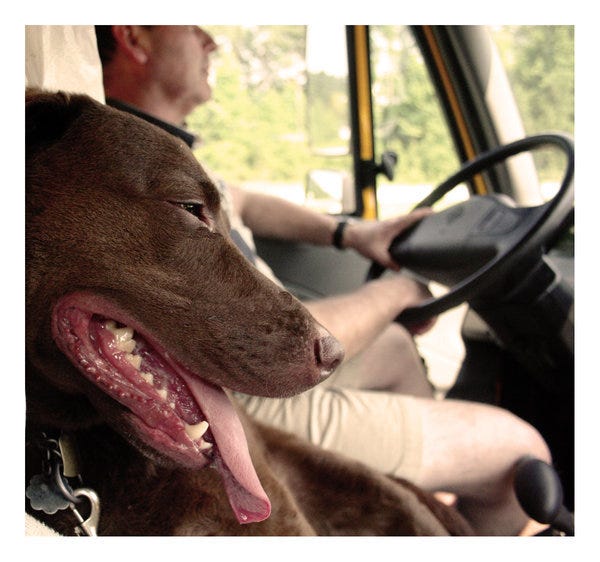
Twenty years ago, my dad and I drove a packed Penske truck down to Florida along with our old dog, Reese. Reese was, let’s just say, a difficult dog. I’ve told the story of her attempting to take a dump next to me as we barreled onto the Cross-Bronx Expressway on so many first dates over the years, as a filtering mechanism of sorts. If the dude doesn’t laugh: out. If he doesn’t mention that he likes dogs: out. For sake of space, I’ll let you dig into the archives for the full story, plus an extra delight of the hilarious feature by classic Tumblr Animals Talking in All Caps.
While I’d hoped that dog attempting to crap in car while on a roadtrip would be a once-in-a-lifetime story, last weekend proved that wrong, this time in a car with no AC while driving through Arizona in July. Maybe we’ll return to it in a few years when it’s a little less…fresh. (Maybe we won’t.)
A Line That Hits
“The beaver’s appetite makes the aspen more generative. The aspen’s abundance makes the beaver’s work possible. What looks like harm is a relationship of mutual insistence.” - Kelton Wright’s piece, long in the tooth
Last weekend, I saw my first beavers in the wild while kayaking through Marble Canyon below the Glen Canyon Dam, a structure that now represents the most critical water chokepoint in the Colorado River Basin. Because of climate change, severe drought and depleted storage, the highly controversial dam, which was not built to withstand the current stress of our climate crisis, is now threatening downstream water delivery for the lower basin states (including Arizona especially). The upstream/downstream effects of our water crisis are stark, literally and figuratively. I let the anger rise up in me in a desert state that has zero water use curtailments at the sight of a bright lawn for a single family home. Seeing those beavers, there was a palpable contrast between how this keystone species has made its home in the wild, and the exploitative ways that humans have done so.
Now is also a great time to learn to eat less meat.
A Modern Mantra
“I would say that there exist a thousand unbreakable links between each of us and everything else, and that our dignity and our chances are one…The pine tree, the leopard, the Platte River, and ourselves—we are at risk together, or we are on our way to a sustainable world together. We are each other’s destiny.”
- Mary Oliver, “Winter Hours” (Upstream)
Something I’m Learning
Often, art can make an impact that a book or article just can’t. I was fortunate over the weekend to see first-hand the introduction of a new art installation and poetry exhibit at the U of A, Language Erratics, by Hannah Larrabee and Jacinda Russell, which came out of an arctic circle artist’s residency and exists as a testament to “the severing of words from what they mean in a warming world.”
A Song to Love
The new album, “Music Fashion Film” by Charlie XCX is chef’s kiss. So many pertinent themes. Climate grief. Being in the stream of the process. Inauthenticity. SS26 is my favorite track but I recommend listening to the whole thing.
A Practice to Try
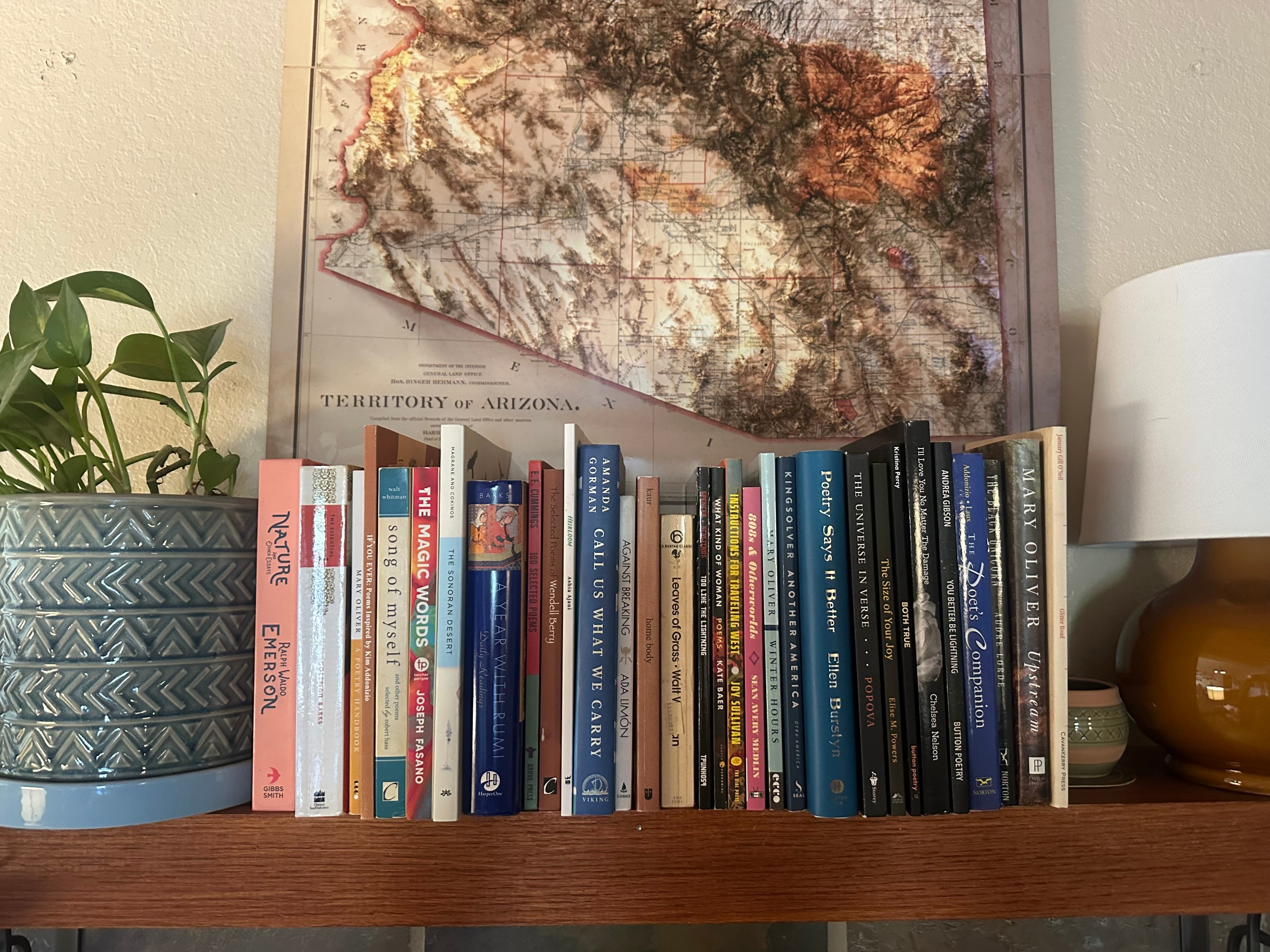
This August, I’m doing The Sealey Challenge, which is designed to be an invitation to read an entire book of poetry every day of the month. I am not doing that but instead I scrounged up 31 essay/poetry books in my house, and I’ll be reading a different book every day for 15-30 minutes.
Notables so far: Mary Oliver’s Upstream and Glitter Road by January Gill O’Neil.
A Bonus Practice
In addition to the drought, I learned that blood is in a severe shortage. I’m going to make an appointment to donate this week. If you can, let’s do it together.
Reminder: August Full Moon Yoga Nidra
The next full moon is Friday, August 28th! Join us at the next virtual yoga nidra session where we’ll use a scientifically backed practice to help manage the downstream effects of modern-day life and learn to go with the flow of the river. Sign up and I will send the calendar, then you pay as you join ($10/session).
There’s a scene from “Hacks” where Deborah tells Ava not to worry about losing her notebook; that if the jokes were good enough, she’ll remember them. So that’s another way of looking at it.
May the beavers show us the way.